


Q: Are dance forms important for competitive exams?
Dance Forms in India: Complete Guide to Classical and Folk Dances with States, Features, and Exam Facts and Download PDF
Feb 05 2026

Indian dance forms are a vital part of India’s cultural heritage, rooted in the Natya Shastra and reflecting spiritual, social, and regional traditions. They include eight classical styles like Bharatanatyam (Tamil Nadu), Kathak (Uttar Pradesh), Kathakali (Kerala), Kuchipudi (Andhra Pradesh), Odissi (Odisha), Manipuri (Manipur), Sattriya (Assam), and Mohiniyattam (Kerala). In India, dance forms can be broadly classified into 2 categories: classical and folk dance forms. Classical dances follow codified techniques, while folk and tribal dances are community-based and celebratory. These traditions play a key role in festivals, rituals, and storytelling. For competitive exams, Indian dance is an important Art and Culture topic, focusing on origins, states, and features.
List of Dance Forms in India PDF 2026 in English
What Are Dance Forms in India?
Dance Forms in India, both classical and folk, are rooted in ancient texts like the Natyashastra and blend spirituality, culture, music, and rhythm. Forms such as Bharatanatyam and Kathak express mythology, devotion, and social life through nritta, nritya, and natya. Dance plays a key role in rituals, festivals, and community celebrations. Nationally, eight classical dances that are admired worldwide for their artistic depth.
Classification of Dance Forms in India
Indian dance includes eight officially recognised classical forms based on the Natyashastra, along with numerous folk and tribal dances reflecting India’s regional diversity. Classical styles such as Bharatanatyam, Kathak, Kathakali, Odissi, Manipuri, Mohiniyattam, Kuchipudi, and Sattriya emphasise codified technique, expression, and storytelling. Folk and tribal dances like Bihu, Garba, Bhangra, Chhau, Kalbelia, and Cheraw are community-centric, celebratory, and closely linked to festivals, harvests, and rituals. Overall, Indian dance represents a balance between structured classical discipline and vibrant regional and indigenous traditions.
List of Classical Dances of India with States
|
List of 8 Classical Dance forms of India, State-wise |
||
|
Classical Dance Forms of India |
State of Origin |
Key Features and Cultural Significance |
|
Bharatanatyam |
Tamil Nadu |
Oldest classical dance form; known for sculpturesque poses, expressive hand gestures (mudras), and devotional themes. |
|
Kathak |
Uttar Pradesh (North, West & Central India) |
Emphasises rhythmic footwork, graceful spins, and narrative expression through gestures. |
|
Kathakali |
Kerala |
Dance-drama style with elaborate costumes, facial makeup, and strong facial expressions. |
|
Kuchipudi |
Andhra Pradesh |
It combines classical dance, drama, and music, often including dialogue delivery and group performance. |
|
Odissi |
Odisha |
Fluid torso movements, sculptural poses, and depiction of stories from Hindu mythology. |
|
Manipuri |
Manipur |
Soft, graceful movements with a focus on themes from Vaishnavism and devotion to Lord Krishna. |
|
Sattriya |
Assam |
Based on the Bhakti movement, performed in satras (monasteries), with devotional and storytelling elements. |
|
Mohiniyattam |
Kerala |
Feminine and elegant dance with slow, graceful swaying movements and expressive eye gestures. |
Famous Books for Competitive Exams
List of Folk Dances in India
Indian folk dances represent the rich culture and traditions of the communities from which they originate. These dances are usually performed during important occasions such as festivals, weddings, and childbirth celebrations, showcasing the joy, customs, and heritage of the people.
|
Origin State |
List of Folk Dances |
|
Andhra Pradesh |
Vilasini Natyam, Bhamakalpam, Veeranatyam, Dappu, Tappeta Gullu, Lambadi, Dhimsa, Kolattam |
|
Arunachal Pradesh |
Buiya, Chalo, Wancho, Pasi Kongki, Ponung, Popir |
|
Assam |
Bihu, Bichhua, Natpuja, Maharas, Kaligopal, Bagurumba, Naga dance, Khel Gopal |
|
Bihar |
Jata-Jatin, Bakho-Bakhain, Panwariya |
|
Chhattisgarh |
Gaur Maria, Panthi, Raut Nacha, Pandwani, Vedamati, Kapalik |
|
Gujarat |
Garba, Dandiya Raas, Tippani Juriun, Bhavai |
|
Goa |
Tarangamel, Koli, Dekhni, Fugdi, Shigmo, Ghode, Modni, Samayi Nrutya, Jagar, Ranmale |
|
Haryana |
Jhumar, Phag, Daph, Dhamal, Loor, Gugga, Khor |
|
Himachal Pradesh |
Jhora, Jhali, Chharhi, Dhaman, Chhapeli, Mahasu |
|
Jammu & Kashmir |
Rauf, Hikat, Mandjas, Kud Dandi Nach |
|
Jharkhand |
Alkap, Karma Munda, Agni, Jhumar, Janani Jhumar, Mardana Jhumar, Paika, Phagua |
|
Karnataka |
Yakshagana, Huttari, Suggi, Kunitha, Karga |
|
Kerala |
Ottam Thullal, Kaikottikali |
|
Maharashtra |
Lavani, Nakata, Koli, Lezim, Gafa, Dahikala, Dasavtar |
|
Madhya Pradesh |
Jawara, Matki, Aada, Khada Nach, Phulpati, Grida Dance, Selalarki, Selabhadoni |
|
Manipur |
Dol Cholam, Thang Ta, Lai Haraoba, Pung Cholom |
|
Meghalaya |
Ka Shad Suk Mynsiem, Nongkrem, Laho |
|
Mizoram |
Cheraw Dance, Khuallam, Chailam, Sawlakin, Chawnglaizawn, Zangtalam |
|
Nagaland |
Rangma, Zeliang, Nsuirolians, Gethinglim |
|
Odisha |
Savari, Ghumara, Painka, Munari |
|
Punjab |
Bhangra, Giddha, Daff, Dhaman, Bhand |
|
Rajasthan |
Ghumar, Chakri, Ganagor, Jhulan Leela, Jhuma, Suisini, Ghapal |
|
Sikkim |
Chu Faat, Sikmari, Singhi Chaam or the Snow Lion, Yak Chaam, Denzong Gnenha, Tashi Yangku |
|
Tamil Nadu |
Kumi, Kolattam, Kavadi |
|
Tripura |
Hojagiri |
|
Uttar Pradesh |
Nautanki, Raslila, Kajri, Jhora, Chappeli |
|
Uttarakhand |
Garhwali, Kumayuni, Kajari, Jhora, Raslila |
Check the Expected Questions from the Dance Forms in India
Difference Between Classical and Folk Dance Forms
Check the Difference Between Classical and Folk Dance Forms in India.
| Difference Between Classical and Folk Dance Forms in India | ||
|---|---|---|
| Basis | Classical Dance | Folk Dance |
| Origin | Originates from ancient Sanskrit treatises like the Natya Shastra and evolved mainly through temple and court traditions. | Emerged from rural and regional traditions, reflecting the daily life, culture, and customs of common people. |
| Training Method | Requires long-term, rigorous training under the Guru–Shishya tradition to master complex techniques, mudras, and expressions. | Learned informally within communities, emphasising enthusiasm, rhythm, and collective participation rather than technical precision. |
| Costumes & Music | Features elaborate, style-specific costumes, makeup, and ornaments, accompanied by classical Carnatic or Hindustani music. | Uses vibrant, region-specific attire with folk music, simple instruments, and traditional songs. |
| Performance Style | Highly structured and disciplined, focusing on grace (Lasya) or power (Tandava) with well-defined choreography. | Energetic and lively, often performed in groups, circles, or lines during festivals and celebrations. |
| Exam Relevance | Questions focus on the eight classical dances and their states of origin. | Emphasis is on identifying major folk dances and linking them with regions and festivals. |
Important Facts About Indian Dance Forms
Indian classical dances are rooted in the Natya Shastra. Eight forms are recognised by the Sangeet Natak Akademi, while the Ministry of Culture includes nine by adding Chhau.
-
Oldest Dance Form: Bharatanatyam is regarded as the oldest classical dance, tracing its origins to ancient Tamil traditions.
-
Regional Origins: Each dance form developed in a specific region—such as Kathak in North India, Kathakali and Mohiniyattam in Kerala, and Sattriya in Assam.
-
Temple & Ritual Connection: Several dances evolved from temple and devotional practices, including Bharatanatyam, Odissi, Kuchipudi, Mohiniyattam, Sattriya, and Manipuri.
Dance Forms in India Pictures
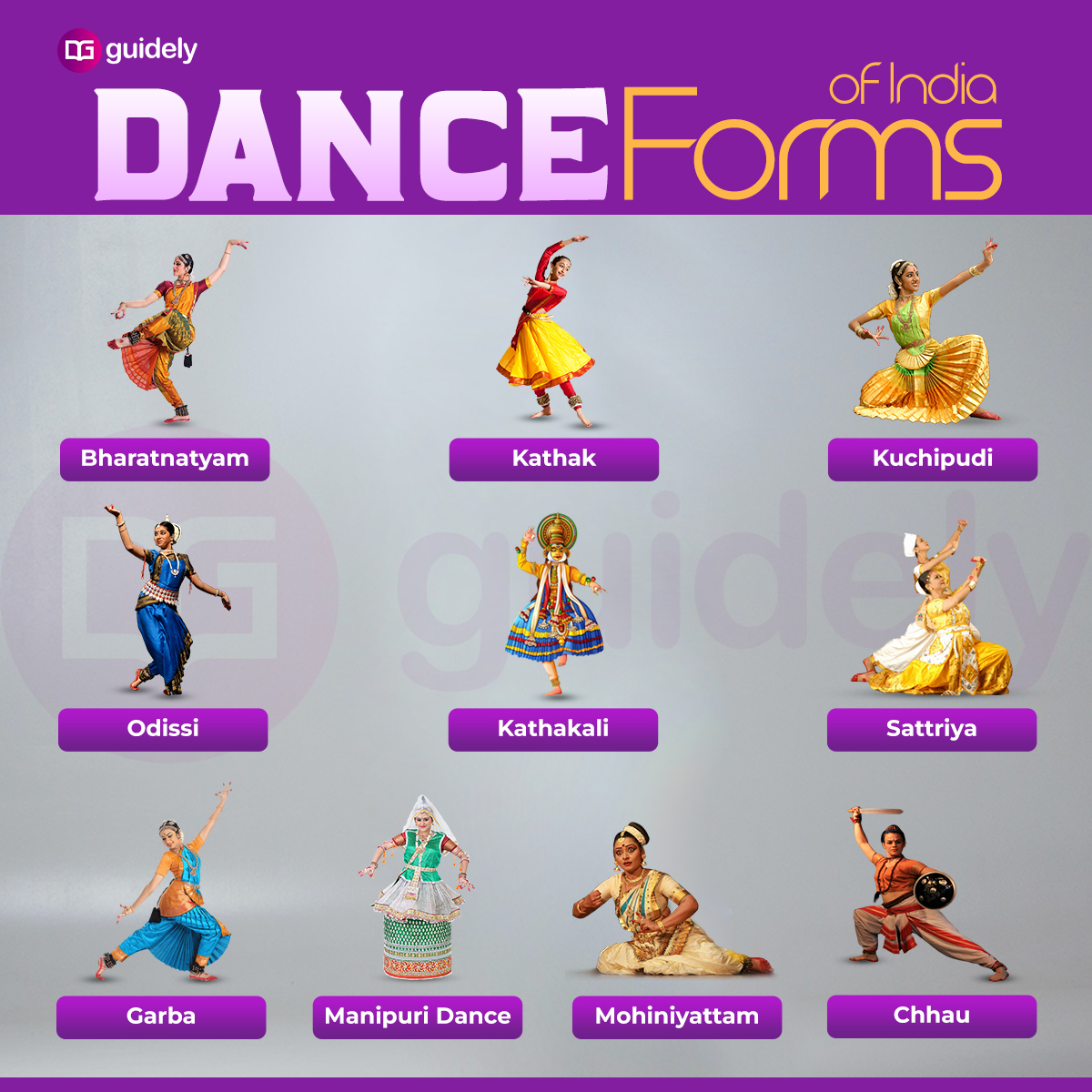
Here are the dance forms in India mentioned in the pictures below for reference.
Dance Forms in India for Competitive Exams
Indian dance forms are an important part of Static GK for UPSC, SSC, and Banking exams. They are broadly classified into Classical and Folk dances. Eight classical forms, such as Bharatanatyam, Kathak, Kathakali, Odissi, and Sattriya, are frequently asked, along with their states, features, and exponents. Folk dances like Bhangra, Garba, Bihu, and Ghoomar are linked to festivals and regions. Exams mainly focus on state–dance pairing, key characteristics, personalities, and UNESCO-recognised dance forms.
National Dance Of India
Bharatanatyam is one of the most popular classical dance forms of India, originating from Tamil Nadu and widely regarded as the national dance form of the country. Its roots can be traced back to the ancient Sanskrit text Natyashastra, written by the sage Bharata, which is the foundation of Indian performing arts.
Traditionally, Bharatanatyam was performed by women in Hindu temples as a form of devotional expression, depicting stories of gods and goddesses through graceful movements and expressions. In the 20th century, the dance form gained global recognition and began to be widely performed on public stages.
Bharatanatyam is known for its distinctive style, with bent knees, rhythmic footwork, expressive eye movements, and intricate hand gestures known as mudras, which are used to narrate mythological and spiritual stories.
List of Tiger Reserves in India
History and Evolution of Classical Dances in India
The history and evolution of classical dances in India can be traced back to ancient temples and sacred scriptures, especially the Natya Shastra, written more than 2,000 years ago by sage Bharata Muni. Indian classical dance developed as a spiritual and artistic expression that beautifully blends storytelling, music, rhythm, and emotion. These dance traditions were preserved through generations across different regions of India, giving rise to the diverse classical dance forms seen today.
According to the Natya Shastra, Lord Brahma created the Natya Veda, the fifth Veda, by combining words from the Rig Veda, gestures from the Yajur Veda, music from the Sam Veda, and emotions from the Atharva Veda. This divine art form was created at the request of the Gods to provide entertainment and spiritual enlightenment to humankind, highlighting the sacred importance of dance in Indian culture.
Indian mythology is rich with references to dance, from Lord Shiva’s Tandava, symbolising creation, preservation, and destruction, to Goddess Parvati’s graceful Lasya, representing beauty and femininity. The social and cultural importance of dance is also evident in ancient archaeological findings, such as the community dance engravings at Bhimbetka and the famous Harappan bronze dancing girl.
The Natya Shastra, compiled between 200 BC and 200 AD, is the earliest and most comprehensive written work on Indian classical dance. It provides detailed guidance on stage design, costumes, ornaments, dance techniques, postures, expressions, and audience engagement. Bharata Muni described dance as the “complete art”, as it brings together music, sculpture, poetry, and drama into one powerful form of expression.

Interesting Facts about Classical Dances of India
Bharatanatyam is one of the oldest and most popular classical dance forms of India, rooted in the principles of Bharata’s Natyashastra. It features a rich repertoire of compositions in Tamil, Telugu, and Sanskrit, expressing themes of Shringara (romantic love) and Bhakti (devotion). Bharatanatyam music follows the Carnatic music tradition of South India and blends rhythm, expression, and storytelling.
Kathak is the principal classical dance of North India and is widely performed in Uttar Pradesh, Rajasthan, Delhi, and Madhya Pradesh. It originated from the storytelling tradition of Kathakaras, who narrated tales from the Ramayana, Mahabharata, and Puranas through expressive movement and rhythm.
Kuchipudi, one of India’s major classical dance styles, originated in Andhra Pradesh and flourished under the influence of the Bhakti movement. It is a dance-drama tradition that combines Nritta (pure dance), Nritya (expressive dance), and Natya (dramatic storytelling) using graceful movements, rhythmic patterns, and symbolic hand gestures.
Odissi developed in Odisha (formerly Orissa) and was originally performed by temple dancers known as Maharis. In the 20th century, it was revived as a classical theatre art inspired by ancient sculptures, paintings, and literary traditions of the region.
Kathakali, meaning “story play,” originated in Kerala during the 17th century. Supported by royal patronage, it evolved into a powerful dance-drama tradition depicting stories from the Ramayana and Mahabharata, known for its elaborate costumes, makeup, and dramatic expressions.
Sattriya is a classical dance form from Assam, developed in the 16th century in Vaishnava monasteries known as Sattras under the guidance of saint-reformer Srimanta Shankaradeva. It is dedicated to Lord Krishna and features refined hand gestures, footwork, expressive storytelling, and devotional themes.
Manipuri dance originated in Manipur and is deeply rooted in the Vaishnava traditions of the Meitei community. It consists of two major forms — Jagoi (Lasya) and Cholom (Tandava) — representing graceful and vigorous dance traditions, respectively.
Mohiniattam is a graceful classical dance from Kerala, named after the mythical enchantress Mohini. It is a solo female dance style known for soft movements, gentle expressions, and temple traditions. The dance uses traditional Kerala rhythms with instruments like the Maddalam and Edakka.
Other Dance Forms of India
|
Particulars |
Description |
|
Chhau |
It is a tribal martial art dance popular in the Indian states of Odisha, Jharkhand, and West Bengal. |
|
Garba |
Garba is a traditional Gujarati folk dance that is performed during Navratri. |
|
Kalbelia |
It is a sensual folk dance performed by the women of Rajasthan’s Kalbelia Community. The serpents’ costumes and dance movements are similar. |
|
Ghoomar |
Ghoomar is a Bhil tribal folk dance honouring the goddess Sarasvati that has now been adopted by various Rajasthani clans. |
|
Dandiya Raas |
The Gujarati folk dance is called dandiya raas. This well-known socio-religious dance, which has its roots in Gujarat, is performed in celebration of Navratri. |
|
Bhangra |
Bhangra is a highly energetic Punjabi folk dance that is enjoyed during festivals. |
List of Dance Forms in India 2026 in Hindi
राज्यों के साथ भारत के नृत्य रूप - भारत में शास्त्रीय नृत्य रूप
यहां हमने आपके संदर्भ के लिए भारत के शास्त्रीय नृत्य रूपों की सूची जैसे तमिलनाडु का शास्त्रीय नृत्य, केरल का शास्त्रीय नृत्य, आंध्र प्रदेश का नृत्य आदि को राज्यवार सारणीबद्ध किया है।
भारत में शास्त्रीय नृत्य रूपों की सूची |
|
|
भारत में शास्त्रीय नृत्यों की सूची |
भारत के राज्यवार नृत्य रूप - उत्पत्ति का राज्य |
|
भरतनाट्यम |
तमिलनाडु |
|
कथक |
उत्तर प्रदेश |
|
कुचिपुड़ी |
आंध्र प्रदेश |
|
ओडिसी |
ओडिशा |
|
कथकली |
केरल |
|
सत्त्रिया नृत्य |
असम |
|
गरबा |
गुजरात |
|
मणिपुरी नृत्य या जागोई |
मणिपुर |
|
मोहिनीअट्टम |
केरल |
छाऊ |
झारखंड, ओडिशा, और पश्चिम बंगाल |
भारत में शीर्ष 10 नृत्य:
भारत के विभिन्न राज्यों में विभिन्न प्रकार के नृत्य पाए जाते हैं। उनमें से कुछ को जन्म से ही बहुत पुराना माना जाता है। यहां हमने आपके संदर्भ के लिए भारत के शीर्ष 10 नृत्यों की सूची सारणीबद्ध की है।
भारत में शीर्ष 10 नृत्य |
|
|
भारत के नृत्यों की सूची |
राज्य |
|
भरतनाट्यम |
तमिलनाडु |
|
कथक |
उत्तर प्रदेश |
|
कथकली |
केरल |
|
मणिपुरी |
मणिपुर |
|
कुचिपुड़ी |
आंध्र प्रदेश |
|
ओडिसी |
ओडिशा |
|
भांगड़ा/गिद्दा |
पंजाब |
|
गरबा |
गुजरात |
|
रौफ़ |
कश्मीर |
|
घूमर |
राजस्थान |
भारत में लोक नृत्य रूपों की सूची:
भारत में लोक नृत्य उस समुदाय की संस्कृति और परंपरा का प्रतिनिधित्व करते हैं जहां से इसकी उत्पत्ति हुई है। लोक नृत्य आमतौर पर संबंधित समुदाय के दौरान किए जाते हैं
उत्सव- प्रसव, त्यौहार, शादियाँ आदि। भारत में विभिन्न प्रकार के लोक नृत्य हैं। यहां हम भारतीय राज्यों में लोक नृत्य रूपों की एक सूची प्रदान कर रहे हैं।
राज्यों के साथ भारत के नृत्य रूप - भारत में लोक नृत्य रूप
लोक नृत्य भी भारत के महत्वपूर्ण नृत्य रूपों में से एक है। यहां हमने आपके संदर्भ के लिए भारत में राज्यवार लोक नृत्यों की सूची जैसे आंध्र प्रदेश के नृत्य, सिक्किमी नृत्य, बिहार के लोक नृत्य, महाराष्ट्र के लोक नृत्य आदि को सारणीबद्ध किया है।
भारत में लोक नृत्य रूपों की सूची - भारत के विभिन्न नृत्य रूप |
|
भारत के राज्यवार नृत्य रूप - उत्पत्ति का राज्य |
भारत में लोक नृत्यों की सूची |
|
आंध्र प्रदेश का नृत्य |
|
|
अंडमान और निकोबार द्वीप समूह |
|
|
अरुणाचल प्रदेश |
|
असम |
|
बिहार का लोक नृत्य |
|
छत्तीसगढ़ |
|
गुजरात |
|
गोवा |
|
हरियाणा |
|
हिमाचल प्रदेश |
|
जम्मू और कश्मीर |
|
झारखंड |
|
कर्नाटक |
|
केरल |
|
लक्षद्वीप |
|
लोक नृत्य में महाराष्ट्र |
|
मध्य प्रदेश |
|
मणिपुर |
|
मेघालय |
|
|
|
मिजोरम |
|
नगालैंड |
|
ओडिशा |
|
पांडिचेरी |
|
पंजाब |
|
राजस्थान |
|
सिक्किम नृत्य |
|
तामिल तमिलनाडु |
|
त्रिपुरा |
|
उत्तर प्रदेश |
|
उत्तराखंड |
|
पश्चिम बंगाल |
|
List of Dance Forms in India PDF 2026 in Hindi
Indian Dance Forms - A Summary
Indian dance forms reflect India’s ancient cultural heritage, blending devotion, storytelling, rhythm, and regional traditions. They are broadly classified into classical and folk dances, both rooted in texts like the Natya Shastra. Classical dances follow codified techniques and evolved from temple traditions, while folk dances are community-based and celebratory. These forms preserve regional music, costumes, and values and enjoy global recognition. For competitive exams such as UPSC, SSC, and Banking, knowledge of dance forms is vital, especially their origins, features, state associations, and the distinction between classical and folk traditions.
FAQs
Q: How many classical dance forms are there in India?
There are 8 classical dances recognised by the Sangeet Natak Akademi: Bharatanatyam, Kathak, Kathakali, Kuchipudi, Manipuri, Mohiniyattam, Odissi, and Sattriya.
Q: Which is the oldest dance form in India?
Bharatanatyam, which originated in Tamil Nadu, is regarded as the oldest classical dance form of India, with a history spanning more than 2,000 years.
Q. What is the difference between classical and folk dances?
Classical dances follow structured grammar, formal training, and religious themes, while folk dances are community-based, performed during festivals, and regionally diverse.
Q: Which organization recognizes classical dance forms?
Yes, Indian dance forms, both classical and folk, are extremely important topics for competitive examinations in India.
Q: What is the national dance of India?
India does not officially have a national dance, but Bharatanatyam is often regarded as one of the most iconic classical dance forms.
Q. What government schemes promote Indian dance forms?
Schemes like Ek Bharat Shreshtha Bharat, Kala Sanskriti Vikas Yojana, and Sangeet Natak Akademi’s grant programs.

Trending Notification
- IBPS RRB Notification
- IBPS Clerk Notification
- SBI PO Notification
- IBPS PO Notification
- SBI Clerk Notification
- SSC JE Notification
- SSC CGL Notification
- SSC CHSL Notification
- SSC MTS Notification
- SSC CPO Notification
- SSC GD Notification
- RRB Group D Notification
- RRB NTPC Notification
- RRB ALP Notification
- RRB JE Notification
General Awareness Smart Analysis (Smart Quiz 2.0)
- Get Weekly 4 set Test
- Each Set consist of 50 Questions
- Compare your progress with Test 1 & 2 & Test 3 & 4
- Deep Analysis in topic wise questions
₹599
₹199
View Package
Super Plan
- All Banking PDF Course 2026, 2025, 2024
- All Banking Video Course
- All Banking Mock Test Series
- All Banking Bundle PDF Courses
- All Banking Ebooks
- All Banking Interview Courses Not Included
₹17990
₹2999
View Package
Premium PDF Course
- Bundle PDF Course 2025
- Premium PDF Course 2024
- Prime PDF Course 2023
₹3999
₹618
View Package