

Data Interpretation Questions for IBPS Clerk: Download Free PDF With Answers and Solutions
Apr 08 2026

Data Interpretation (DI) plays a crucial role in the IBPS Clerk exam, especially in the Quantitative Aptitude section. If you’re aiming to clear the IBPS Clerk, mastering DI questions can give you a strong scoring advantage. Unlike complex math topics, DI is more about understanding data and applying basic concepts such as percentages, ratios, and averages in a smart way. Most DI questions in IBPS Clerk are easy to moderate, which means they are highly scoreable if you practice consistently. The key is not just solving questions, but improving your speed and accuracy over time. When you become comfortable reading tables, charts, and graphs, you can utilise your valuable time in the exam. Think of it, DI is your best opportunity to boost your score with confidence. With regular practice, mock tests, and the right approach, you can turn this section into one of your strongest areas and improve your overall exam performance.
Download IBPS Clerk DI Questions PDF
Candidates can access data interpretation questions with solutions PDFs given below.
What are DI Questions for IBPS Clerk?
IBPS Clerk DI (Data Interpretation) questions are asked by analysing numerical data presented in the form of tables, bar graphs, pie charts, or line graphs. You have to interpret the data and answer related questions. This section evaluates your calculation speed, accuracy, and data analysis skills.
Importance of DI in IBPS Clerk Exam
Knowing the importance of DI questions for IBPS Clerk helps you understand better.
-
Around 5–10 questions are asked from DI, so utilising it is important
-
Helps increase attempts with good accuracy
-
Compared to other quantitative topics, its is easier
Types of DI Questions Asked in IBPS Clerk
Here we provided some of the types for your reference.
-
Table DI
-
Bar Graph DI
-
Pie Chart DI
-
Line Graph DI
-
Basic Caselet DI
-
Mixed DI
-
Bubble Char DI, etc.
IBPS Clerk (CSA) Cut-Off Details
DI Practice Questions for IBPS Clerk
Here, we provided some examples for your reference and practice to improve your performance.
Study the following information carefully and answer the questions given below.
There are four departments [A, B, C and D] in a university. Each department has a different number of male and female students, which is given below.
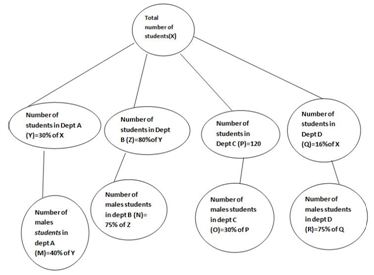
1) Average age of male students of Deptt A is 24 years, and average age of female students of Deptt A is 22 years. Find the average age of all the students in the class?
A.24.9years
B.23.5 years
C.22.8 years
D.20.6 years
E.27.6 years
Answer: C
So, average age = [48*24+72*22]/120=22.8 years
2) Find the difference between the percentage of females in Dept C out of total students in the university and the percentage of females in Dept D out of total students in the university?
A.11%
B..14%
C.15%
D.17%
E.20%
Answer: D
Required difference = [84/400] *100 – [16/400] *100 = 17%
3) Ratio between male students pursuing graduate and master's degrees in Dept D is 3:5, and the ratio between female students pursuing graduate and master's degrees in Dept D is 3:1. Find the total number of students pursuing a graduate degree?
A.32
B.30
C.37
D.39
E.None of these
Answer: B
Total number of students pursuing a graduate degree
=48*3/8 + 16*3/4 = 18 +12=30
4) Total number of males in all departments together is what per cent of the total number of females in all departments together?
A.104.08%
B.112.35%
C.102.31%
D.107.39%
E.None of these
Answer: A
Required percentage = [(48+72+36+48)/(72+24+84+16)]*100=104.08%
5) I is the sum of the male students in dept A and B together, and J is the sum of female students in dept C and D together. Find the value of (I*Q) + (J*Z)?
A.17280
B.12452
C.14560
D.17740
E. None of these
Answer: A
I=48+72=120, j=84+16=100
I*Q + j*Z=120*64+96*100=17280
Tips to Solve DI Questions Quickly
The following tips help you manage your time and score more in this section.
-
Practice basic calculations daily
-
Learn percentage and ratio shortcuts
-
Start with easy questions
-
Avoid lengthy calculations
-
Use approximation techniques
Free Download IBPS Clerk Previous Year Question Paper
Common Mistakes to Avoid
Avoiding these mistakes helps candidates score better in the IBPS Clerk in this section.
-
Understanding data wrongly
-
Making errors during calculation
-
Taking more time for one question
-
Neglecting an easy question
Best Strategy to Prepare DI for IBPS Clerk
Mastering these strategies can help your overall performance.
-
Practice 2–3 DI sets daily
-
Solve the previous year's questions
-
Take mock tests regularly
-
Improve speed and accuracy
-
Revise concepts regularly
FAQs – DI Questions for IBPS Clerk
Q. Are DI questions asked in the IBPS Clerk exam?
Yes, DI questions are part of the quantitative aptitude section.
Q. Is DI easy in IBPS Clerk?
Yes, DI is usually easy to moderate in difficulty.
Q. How to prepare DI for IBPS Clerk?
Practice regularly, improve calculation speed, and solve mock tests.
Q. How many DI questions are asked?
Around 5–10 DI questions are asked in prelims.
Q. Which DI topics are important?
Table, bar graph, and pie chart DI are important.

IBPS Clerk Prelims PDF Course 2026
- Course Duration: 50 days
- No.of Ques: 5800+
Mains Booster Bundle Course 2026
- Total Number of Questions: 9000+ questions
- Language: English & Hindi
- Exact Exam Level Questions
- Purely Based on Exact Exam Level & New Pattern
Computer Certification Course For IBPS Clerk, RRB PO and RBI Assistant
- 25+ Interactive Video Classes
- ISO & NASSCOM ® certified Company Certificate.
- This Certificate is valid for All Banking Exams.
- Give Online Test and Get Computer Certificate*
- 24*7 Access to Recorded Videos.
- Bilingual Medium (Explanation in Hindi & Content in English)
IBPS Clerk Prelims 2026
- 1 Free + 19 Full + 15 Sectional Tests
- Bilingual (English & Hindi)
- Latest Pattern Questions
- Access in Mobile app & Website